MoreExam
1. Question Content...
EXPLANATION
Answer: X - EXPLANATION Content.
Question1: You have been tasked with deploying prototype code to production. The feature engineering code is in PySpark and runs on Dataproc Serverless. The model training is executed by using a Vertex Al custom training job. The two steps are not connected, and the model training mustcurrently be run manually after the feature engineering step finishes. You need to create a scalable and maintainable production process that runs end-to-end and tracks the connections between steps. What should you do?
Question2: You work for a bank and are building a random forest model for fraud detection. You have a dataset that includes transactions, of which 1% are identified as fraudulent. Which data transformation strategy would likely improve the performance of your classifier?
Question3: You work for an online retail company that is creating a visual search engine. You have set up an end-to-end ML pipeline on Google Cloud to classify whether an image contains your company's product. Expecting the release of new products in the near future, you configured a retraining functionality in the pipeline so that new data can be fed into your ML models. You also want to use Al Platform's continuous evaluation service to ensure that the models have high accuracy on your test data set. What should you do?
Question4: Your organization wants to make its internal shuttle service route more efficient. The shuttles currently stop at all pick-up points across the city every 30 minutes between 7 am and 10 am. The development team has already built an application on Google Kubernetes Engine that requires users to confirm their presence and shuttle station one day in advance. What approach should you take?
Question5: You need to quickly build and train a model to predict the sentiment of customer reviews with custom categories without writing code. You do not have enough data to train a model from scratch. The resulting model should have high predictive performance. Which service should you use?
Question6: While performing exploratory data analysis on a dataset, you find that an important categorical feature has 5% null values. You want to minimize the bias that could result from the missing values. How should you handle the missing values?
Question7: You recently deployed a model lo a Vertex Al endpoint and set up online serving in Vertex Al Feature Store.You have configured a daily batch ingestion job to update your featurestore During the batch ingestion jobs you discover that CPU utilization is high in your featurestores online serving nodes and that feature retrieval latency is high. You need to improve online serving performance during the daily batch ingestion. What should you do?
Question8: You work for the AI team of an automobile company, and you are developing a visual defect detection model using TensorFlow and Keras. To improve your model performance, you want to incorporate some image augmentation functions such as translation, cropping, and contrast tweaking. You randomly apply these functions to each training batch. You want to optimize your data processing pipeline for run time and compute resources utilization. What should you do?
Question9: You recently trained an XGBoost model on tabular data You plan to expose the model for internal use as an HTTP microservice After deployment you expect a small number of incoming requests. You want to productionize the model with the least amount of effort and latency. What should you do?
Question10: You are an ML engineer at a regulated insurance company. You are asked to develop an insurance approval model that accepts or rejects insurance applications from potential customers. What factors should you consider before building the model?
Question11: You need to deploy a scikit-learn classification model to production. The model must be able to serve requests24/7 and you expect millions of requests per second to the production application from 8 am to 7 pm. You need to minimize the cost of deployment What should you do?
Question12: You are profiling the performance of your TensorFlow model training time and notice a performance issue caused by inefficiencies in the input data pipeline for a single 5 terabyte CSV file dataset on Cloud Storage.You need to optimize the input pipeline performance. Which action should you try first to increase the efficiency of your pipeline?
Question13: You have created a Vertex Al pipeline that includes two steps. The first step preprocesses 10 TB data completes in about 1 hour, and saves the result in a Cloud Storage bucket The second step uses the processed data to train a model You need to update the model's code to allow you to test different algorithms You want to reduce pipeline execution time and cost, while also minimizing pipeline changes What should you do?
Question14: You deployed an ML model into production a year ago. Every month, you collect all raw requests that were sent to your model prediction service during the previous month. You send a subset of these requests to a human labeling service to evaluate your model'sperformance. After a year, you notice that your model's performance sometimes degrades significantly after a month, while other times it takes several months to notice any decrease in performance. The labeling service is costly, but you also need to avoid large performance degradations. You want to determine how often you should retrain your model to maintain a high level of performance while minimizing cost. What should you do?
Question15: You work with a data engineering team that has developed a pipeline to clean your dataset and save it in a Cloud Storage bucket. You have created an ML model and want to use the data to refresh your model as soon as new data is available. As part of your CI/CD workflow, you want to automatically run a Kubeflow Pipelines training job on Google Kubernetes Engine (GKE). How should you architect this workflow?
Question16: You are experimenting with a built-in distributed XGBoost model in Vertex AI Workbench user-managed notebooks. You use BigQuery to split your data into training and validation sets using the following queries:CREATE OR REPLACE TABLE 'myproject.mydataset.training' AS(SELECT * FROM 'myproject.mydataset.mytable' WHERE RAND() <= 0.8);CREATE OR REPLACE TABLE 'myproject.mydataset.validation' AS(SELECT * FROM 'myproject.mydataset.mytable' WHERE RAND() <= 0.2);After training the model, you achieve an area under the receiver operating characteristic curve (AUC ROC) value of 0.8, but after deploying the model to production, you notice that your model performance has dropped to an AUC ROC value of 0.65. What problem is most likely occurring?
Question17: You work for a startup that has multiple data science workloads. Your compute infrastructure is currently on-premises. and the data science workloads are native to PySpark Your team plans to migrate their data science workloads to Google Cloud You need to build a proof of concept to migrate one data science job to Google Cloud You want to propose a migration process that requires minimal cost and effort. What should you do first?
Question18: Your team trained and tested a DNN regression model with good results. Six months after deployment, the model is performing poorly due to a change in the distribution of the input data. How should you address the input differences in production?
Question19: You work for a delivery company. You need to design a system that stores and manages features such as parcels delivered and truck locations over time. The system must retrieve the features with low latency and feed those features into a model for online prediction. The data science team will retrieve historical data at a specific point in time for model training. You want to store the features with minimal effort. What should you do?
Question20: You are developing an ML model that uses sliced frames from video feed and creates bounding boxes around specific objects. You want to automate the following steps in your training pipeline: ingestion and preprocessing of data in Cloud Storage, followed by training and hyperparameter tuning of the object model using Vertex AI jobs, and finallydeploying the model to an endpoint. You want to orchestrate the entire pipeline with minimal cluster management. What approach should you use?
Question21: You are working with a dataset that contains customer transactions. You need to build an ML model to predict customer purchase behavior You plan to develop the model in BigQuery ML, and export it to Cloud Storage for online prediction You notice that the input data contains a few categorical features, including product category and payment method You want to deploy the model as quickly as possible. What should you do?
Question22: While monitoring your model training's GPU utilization, you discover that you have a native synchronous implementation. The training data is split into multiple files. You want to reduce the execution time of your input pipeline. What should you do?
Question23: You developed a Transformer model in TensorFlow to translate text Your training data includes millions of documents in a Cloud Storage bucket. You plan to use distributed training to reduce training time. You need to configure the training job while minimizing the effort required to modify code and to manage the clusters configuration. What should you do?
Question24: You need to use TensorFlow to train an image classification model. Your dataset is located in a Cloud Storage directory and contains millions of labeled images Before training the model, you need to prepare the data. You want the data preprocessing and model training workflow to be as efficient scalable, and low maintenance as possible. What should you do?
Question25: You work for a biotech startup that is experimenting with deep learning ML models based on properties of biological organisms. Your team frequently works on early-stage experiments with new architectures of ML models, and writes custom TensorFlow ops in C++. You train your models on large datasets and large batch sizes. Your typical batch size has 1024 examples, and each example is about 1 MB in size. The average size of a network with all weights and embeddings is 20 GB. What hardware should you choose for your models?
Question26: You are building a real-time prediction engine that streams files which may contain Personally Identifiable Information (Pll) to Google Cloud. You want to use the Cloud Data Loss Prevention (DLP) API to scan the files. How should you ensure that the Pll is not accessible by unauthorized individuals?
Question27: You created an ML pipeline with multiple input parameters. You want to investigate the tradeoffs between different parameter combinations. The parameter options are* input dataset* Max tree depth of the boosted tree regressor* Optimizer learning rateYou need to compare the pipeline performance of the different parameter combinations measured in F1 score, time to train and model complexity. You want your approach to be reproducible and track all pipeline runs on the same platform. What should you do?
Question28: You are developing ML models with Al Platform for image segmentation on CT scans. You frequently update your model architectures based on the newest available research papers, and have to rerun training on the same dataset to benchmark their performance. You want to minimize computation costs and manual intervention while having version control for your code. What should you do?
Question29: You recently joined an enterprise-scale company that has thousands of datasets. You know that there are accurate descriptions for each table in BigQuery, and you are searching for the proper BigQuery table to use for a model you are building on AI Platform. How should you find the data that you need?
Question30: You are developing a training pipeline for a new XGBoost classification model based on tabular data The data is stored in a BigQuery table You need to complete the following steps1. Randomly split the data into training and evaluation datasets in a 65/35 ratio2. Conduct feature engineering3 Obtain metrics for the evaluation dataset.4 Compare models trained in different pipeline executionsHow should you execute these steps'?
Question31: You manage a team of data scientists who use a cloud-based backend system to submit training jobs. This system has become very difficult to administer, and you want to use a managed service instead. The data scientists you work with use many different frameworks, including Keras, PyTorch, theano. Scikit-team, and custom libraries. What should you do?
Question32: You work on a data science team at a bank and are creating an ML model to predict loan default risk. You have collected and cleaned hundreds of millions of records worth of training data in a BigQuery table, and you now want to develop and compare multiple models on this data using TensorFlow and Vertex AI. You want to minimize any bottlenecks during the data ingestion state while considering scalability. What should you do?
Question33: You are working on a Neural Network-based project. The dataset provided to you has columns with different ranges. While preparing the data for model training, you discover that gradient optimization is having difficulty moving weights to a good solution. What should you do?
Question34: You are training a custom language model for your company using a large dataset. You plan to use the ReductionServer strategy on Vertex Al. You need to configure the worker pools of the distributed training job.What should you do?
Question35: You recently built the first version of an image segmentation model for a self-driving car. After deploying the model, you observe a decrease in the area under the curve (AUC) metric. When analyzing the video recordings, you also discover that the model fails in highly congested traffic but works as expected when there is less traffic. What is the most likely reason for this result?
Question36: You work for a gaming company that has millions of customers around the world. All games offer a chat feature that allows players to communicate with each other in real time. Messages can be typed in more than20 languages and are translated in real time using the Cloud Translation API. You have been asked to build an ML system to moderate the chat in real time while assuring that the performance is uniform across the various languages and without changing the serving infrastructure.You trained your first model using an in-house word2vec model for embedding the chat messages translated by the Cloud Translation API. However, the model has significant differences in performance across the different languages. How should you improve it?
Question37: You are developing a custom image classification model in Python. You plan to run your training application on Vertex Al Your input dataset contains several hundred thousand small images You need to determine how to store and access the images for training. You want to maximize data throughput and minimize training time while reducing the amount of additional code. What should you do?
Question38: You are developing an ML model to identify your company s products in images. You have access to over one million images in a Cloud Storage bucket. You plan to experiment with different TensorFlow models by using Vertex Al Training You need to read images at scale during training while minimizing data I/O bottlenecks What should you do?
Question39: You are working on a binary classification ML algorithm that detects whether an image of a classified scanned document contains a company's logo. In the dataset, 96% of examples don't have the logo, so the dataset is very skewed. Which metrics would give you the most confidence in your model?
Question40: You are developing an ML model intended to classify whether X-Ray images indicate bone fracture risk. You have trained on Api Resnet architecture on Vertex AI using a TPU as an accelerator, however you are unsatisfied with the trainning time and use memory usage. You want to quickly iterate your training code but make minimal changes to the code. You also want to minimize impact on the models accuracy. What should you do?
Question41: You need to execute a batch prediction on 100 million records in a BigQuery table with a custom TensorFlow DNN regressor model, and then store the predicted results in a BigQuery table. You want to minimize the effort required to build this inference pipeline. What should you do?
Question42: You are creating a deep neural network classification model using a dataset with categorical input values.Certain columns have a cardinality greater than 10,000 unique values. How should you encode these categorical values as input into the model?
Question43: You want to train an AutoML model to predict house prices by using a small public dataset stored in BigQuery. You need to prepare the data and want to use the simplest most efficient approach. What should you do?
Question44: You need to design a customized deep neural network in Keras that will predict customer purchases based on their purchase history. You want to explore model performance using multiple model architectures, store training data, and be able to compare the evaluation metrics in the same dashboard. What should you do?
Question45: You are investigating the root cause of a misclassification error made by one of your models. You used Vertex Al Pipelines to tram and deploy the model. The pipeline reads data from BigQuery. creates a copy of the data in Cloud Storage in TFRecord format trains the model in Vertex Al Training on that copy, and deploys the model to a Vertex Al endpoint. You have identified the specific version of that model that misclassified: and you need to recover the data this model was trained on. How should you find that copy of the data'?
Question46: You developed a custom model by using Vertex Al to forecast the sales of your company s products based on historical transactional data You anticipate changes in the feature distributions and the correlations between the features in the near future You also expect to receive a large volume of prediction requests You plan to use Vertex Al Model Monitoring for drift detection and you want to minimize the cost. What should you do?
Question47: You have developed a BigQuery ML model that predicts customer churn and deployed the model to Vertex Al Endpoints. You want to automate the retraining of your model by using minimal additional code when model feature values change. You also want to minimize the number of times that your model is retrained to reduce training costs. What should you do?
Question48: You are developing a Kubeflow pipeline on Google Kubernetes Engine. The first step in the pipeline is to issue a query against BigQuery. You plan to use the results of thatquery as the input to the next step in your pipeline. You want to achieve this in the easiest way possible. What should you do?
Question49: You are training an ML model on a large dataset. You are using a TPU to accelerate the training process You notice that the training process is taking longer than expected. You discover that the TPU is not reaching its full capacity. What should you do?
Question50: Your work for a textile manufacturing company. Your company has hundreds of machines and each machine has many sensors. Your team used the sensory data to build hundreds of ML models that detect machine anomalies Models are retrained daily and you need to deploy these models in a cost-effective way. The models must operate 24/7 without downtime and make sub millisecond predictions. What should you do?
Question51: You have written unit tests for a Kubeflow Pipeline that require custom libraries. You want to automate the execution of unit tests with each new push to your development branch in Cloud Source Repositories. What should you do?
Question52: You are developing a model to predict whether a failure will occur in a critical machine part. You have a dataset consisting of a multivariate time series and labels indicating whether the machine part failed You recently started experimenting with a few different preprocessing and modeling approaches in a Vertex Al Workbench notebook. You want to log data and track artifacts from each run. How should you set up your experiments?
Question53: You work for a large technology company that wants to modernize their contact center. You have been asked to develop a solution to classify incoming calls by product so that requests can be more quickly routed to the correct support team. You have already transcribed the calls using the Speech-to-Text API. You want to minimize data preprocessing and development time. How should you build the model?
Question54: You built a deep learning-based image classification model by using on-premises data. You want to use Vertex Al to deploy the model to production Due to security concerns you cannot move your data to the cloud. You are aware that the input data distribution might change over time You need to detect model performance changes in production. What should you do?
Question55: Your company manages an application that aggregates news articles from many different online sources and sends them to users. You need to build a recommendationmodel that will suggest articles to readers that are similar to the articles they are currently reading. Which approach should you use?
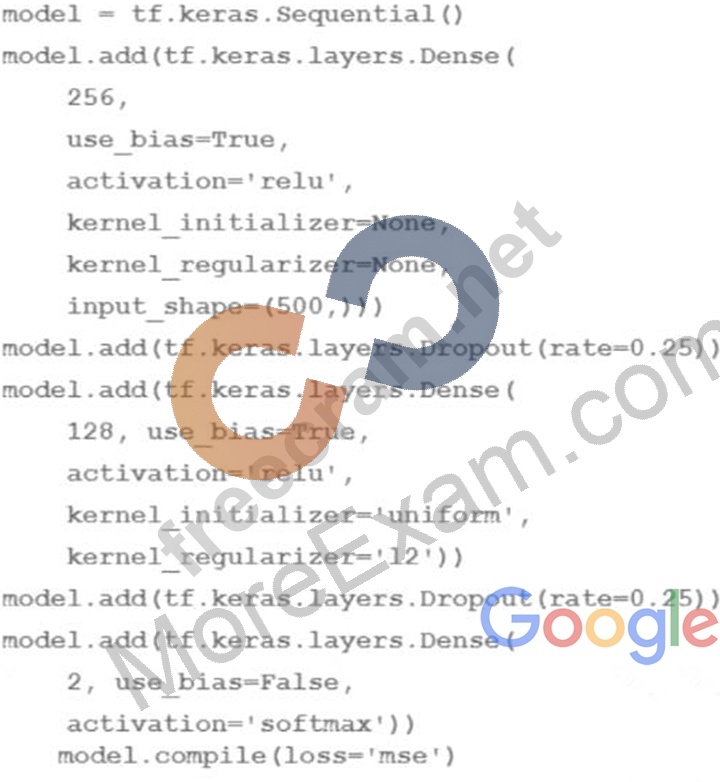
Question56: You are going to train a DNN regression model with Keras APIs using this code:How many trainable weights does your model have? (The arithmetic below is correct.)
Question57: You have recently created a proof-of-concept (POC) deep learning model. You are satisfied with the overall architecture, but you need to determine the value for a couple of hyperparameters. You want to perform hyperparameter tuning on Vertex AI to determine both the appropriate embedding dimension for a categorical feature used by your model and the optimal learning rate. You configure the following settings:For the embedding dimension, you set the type to INTEGER with a minValue of 16 and maxValue of 64.For the learning rate, you set the type to DOUBLE with a minValue of 10e-05 and maxValue of 10e-02.You are using the default Bayesian optimization tuning algorithm, and you want to maximize model accuracy.Training time is not a concern. How should you set the hyperparameter scaling for each hyperparameter and the maxParallelTrials?
Question58: You are training an object detection machine learning model on a dataset that consists of three million X-ray images, each roughly 2 GB in size. You are using Vertex AI Training to run a custom training application on a Compute Engine instance with 32-cores, 128 GB of RAM, and 1 NVIDIA P100 GPU. You notice that model training is taking a very long time. You want to decrease training time without sacrificing model performance.What should you do?
Question59: You work for a bank. You have created a custom model to predict whether a loan application should be flagged for human review. The input features are stored in a BigQuery table. The model is performing well and you plan to deploy it to production. Due to compliance requirements the model must provide explanations for each prediction. You want to add this functionality to your model code with minimal effort and provide explanations that are as accurate as possible What should you do?
Question60: You are building an ML model to detect anomalies in real-time sensor data. You will use Pub/Sub to handle incoming requests. You want to store the results for analytics and visualization. How should you configure the pipeline?
Question61: You manage a team of data scientists who use a cloud-based backend system to submit training jobs. This system has become very difficult to administer, and you want to use a managed service instead. The data scientists you work with use many different frameworks, including Keras, PyTorch, theano, scikit-learn, and custom libraries. What should you do?
Question62: Your team is building a convolutional neural network (CNN)-based architecture from scratch. The preliminary experiments running on your on-premises CPU-only infrastructure were encouraging, but have slow convergence. You have been asked to speed up model training to reduce time-to-market. You want to experiment with virtual machines (VMs) on Google Cloud to leverage more powerful hardware. Your code does not include any manual device placement and has not been wrapped in Estimator model-level abstraction.Which environment should you train your model on?
Question63: You work for a social media company. You want to create a no-code image classification model for an iOS mobile application to identify fashion accessories You have a labeled dataset in Cloud Storage You need to configure a training workflow that minimizes cost and serves predictions with the lowest possible latency What should you do?
Question64: You are an ML engineer at a bank that has a mobile application. Management has asked you to build an ML-based biometric authentication for the app that verifies a customer's identity based on their fingerprint.Fingerprints are considered highly sensitive personal information and cannot be downloaded and stored into the bank databases. Which learning strategy should you recommend to train and deploy this ML model?
Question65: You lead a data science team at a large international corporation. Most of the models your team trains are large-scale models using high-level TensorFlow APIs on AI Platform with GPUs. Your team usually takes a few weeks or months to iterate on a new version of a model. You were recently asked to review your team's spending. How should you reduce your Google Cloud compute costs without impacting the model's performance?
Question66: You are building a MLOps platform to automate your company's ML experiments and model retraining. You need to organize the artifacts for dozens of pipelines How should you store the pipelines' artifacts'?
Question67: Your team needs to build a model that predicts whether images contain a driver's license, passport, or credit card. The data engineering team already built the pipeline and generated a dataset composed of 10,000 images with driver's licenses, 1,000 images with passports, and 1,000 images with credit cards. You now have to train a model with the following label map: ['driversjicense', 'passport', 'credit_card']. Which loss function should you use?
Question68: You work for a retail company. You have been tasked with building a model to determine the probability of churn for each customer. You need the predictions to be interpretable so the results can be used to develop marketing campaigns that target at-risk customers. What should you do?
Question69: You are pre-training a large language model on Google Cloud. This model includes custom TensorFlow operations in the training loop Model training will use a large batch size, and you expect training to take several weeks You need to configure a training architecture that minimizes both training time and compute costs What should you do?
Question70: You are building a predictive maintenance model to preemptively detect part defects in bridges. You plan to use high definition images of the bridges as model inputs. You need to explain the output of the model to the relevant stakeholders so they can take appropriate action. How should you build the model?
Question71: You work for a telecommunications company You're building a model to predict which customers may fail to pay their next phone bill. The purpose of this model is to proactively offer at-risk customers assistance such as service discounts and bill deadline extensions. The data is stored in BigQuery, and the predictive features that are available for model training include- Customer_id -Age- Salary (measured in local currency) -Sex-Average bill value (measured in local currency)- Number of phone calls in the last month (integer) -Average duration of phone calls (measured in minutes) You need to investigate and mitigate potential bias against disadvantaged groups while preserving model accuracy What should you do?
Question72: You work for a bank You have been asked to develop an ML model that will support loan application decisions. You need to determine which Vertex Al services to include in the workflow You want to track the model's training parameters and the metrics per training epoch. You plan to compare the performance of each version of the model to determine the best model based on your chosen metrics. Which Vertex Al services should you use?
Question73: You recently trained a XGBoost model that you plan to deploy to production for online inference Before sending a predict request to your model's binary you need to perform a simple data preprocessing step This step exposes a REST API that accepts requests in your internal VPC Service Controls and returns predictions You want to configure this preprocessing step while minimizing cost and effort What should you do?
Question74: You are a data scientist at an industrial equipment manufacturing company. You are developing a regression model to estimate the power consumption in the company's manufacturing plants based on sensor data collected from all of the plants. The sensors collect tens of millions of records every day. You need to schedule daily training runs foryour model that use all the data collected up to the current date. You want your model to scale smoothly and require minimal development work. What should you do?
Question75: While running a model training pipeline on Vertex Al, you discover that the evaluation step is failing because of an out-of-memory error. You are currently using TensorFlow Model Analysis (TFMA) with a standard Evaluator TensorFlow Extended (TFX) pipeline component for the evaluation step. You want to stabilize the pipeline without downgrading the evaluation quality while minimizing infrastructure overhead. What should you do?
Question76: You work for an online publisher that delivers news articles to over 50 million readers. You have built an AI model that recommends content for the company's weekly newsletter. A recommendation is considered successful if the article is opened within two days of the newsletter's published date and the user remains on the page for at least one minute.All the information needed to compute the success metric is available in BigQuery and is updated hourly. The model is trained on eight weeks of data, on average its performance degrades below the acceptable baseline after five weeks, and training time is 12 hours. You want to ensure that the model's performance is above the acceptable baseline while minimizing cost. How should you monitor the model to determine when retraining is necessary?
Question77: You recently created a new Google Cloud Project After testing that you can submit a Vertex Al Pipeline job from the Cloud Shell, you want to use a Vertex Al Workbench user-managed notebook instance to run your code from that instance You created the instance and ran the code but this time the job fails with an insufficient permissions error. What should you do?
Question78: You are developing an ML model using a dataset with categorical input variables. You have randomly split half of the data into training and test sets. After applying one-hot encoding on the categorical variables in the training set, you discover that one categorical variable is missing from the test set. What should you do?
Question79: You work for a social media company. You need to detect whether posted images contain cars. Each training example is a member of exactly one class. You have trained an object detection neural network and deployed the model version to Al Platform Prediction for evaluation. Before deployment, you created an evaluation job and attached it to the Al Platform Prediction model version. You notice that the precision is lower than your business requirements allow. How should you adjust the model's final layer softmax threshold to increase precision?
Question80: You have deployed a scikit-learn model to a Vertex Al endpoint using a custom model server. You enabled auto scaling; however, the deployed model fails to scale beyond one replica, which led to dropped requests.You notice that CPU utilization remains low even during periods of high load. What should you do?
Question81: You recently deployed a scikit-learn model to a Vertex Al endpoint You are now testing the model on live production traffic While monitoring the endpoint. you discover twice as many requests per hour than expected throughout the day You want the endpoint to efficiently scale when the demand increases in the future to prevent users from experiencing high latency What should you do?
Question82: You are creating a social media app where pet owners can post images of their pets. You have one million user uploaded images with hashtags. You want to build a comprehensive system that recommends images to users that are similar in appearance to their own uploaded images.What should you do?
Question83: You work for a gaming company that manages a popular online multiplayer game where teams with 6 players play against each other in 5-minute battles. There are many newplayers every day. You need to build a model that automatically assigns available players to teams in real time. User research indicates that the game is more enjoyable when battles have players with similar skill levels. Which business metrics should you track to measure your model's performance? (Choose One Correct Answer)
Question84: You work for a pharmaceutical company based in Canada. Your team developed a BigQuery ML model to predict the number of flu infections for the next month in Canada Weather data is published weekly and flu infection statistics are published monthly. You need to configure a model retraining policy that minimizes cost What should you do?
Question85: You need to train a regression model based on a dataset containing 50,000 records that is stored in BigQuery.The data includes a total of 20 categorical and numerical features with a target variable that can include negative values. You need to minimize effort and training time while maximizing model performance. What approach should you take to train this regression model?
Question86: You work for a retail company. You have been asked to develop a model to predict whether a customer will purchase a product on a given day. Your team has processed the company's sales data, and created a table with the following rows:* Customer_id* Product_id* Date* Days_since_last_purchase (measured in days)* Average_purchase_frequency (measured in 1/days)* Purchase (binary class, if customer purchased product on the Date)You need to interpret your models results for each individual prediction. What should you do?
Question87: You are developing a model to identify traffic signs in images extracted from videos taken from the dashboard of a vehicle. You have a dataset of 100 000 images that were cropped to show one out of ten different traffic signs. The images have been labeled accordingly for model training and are stored in a Cloud Storage bucket You need to be able to tune the model during each training run. How should you train the model?
Question88: You work for a large hotel chain and have been asked to assist the marketing team in gathering predictions for a targeted marketing strategy. You need to make predictions about user lifetime value (LTV) over the next 30 days so that marketing can be adjusted accordingly. The customer dataset is in BigQuery, and you are preparing the tabular data for training with AutoML Tables. This data has a time signal that is spread across multiple columns. How should you ensure that AutoML fits the best model to your data?
Question89: You work at a gaming startup that has several terabytes of structured data in Cloud Storage. This data includes gameplay time data, user metadata, and game metadata. You want to build a model that recommends new games to users that requires the least amount of coding. What should you do?
Question90: You need to build classification workflows over several structured datasets currently stored in BigQuery.Because you will be performing the classification several times, you want to complete the following steps without writing code: exploratory data analysis, feature selection, model building, training, and hyperparameter tuning and serving. What should you do?
Question91: You are developing an ML model to identify your company s products in images. You have access to over one million images in a Cloud Storage bucket. You plan to experiment with different TensorFlow models by using Vertex Al Training You need to read images at scale during training while minimizing data I/O bottlenecks What should you do?
Question92: You have built a custom model that performs several memory-intensive preprocessing tasks before it makes a prediction. You deployed the model to a Vertex Al endpoint. and validated that results were received in a reasonable amount of time After routing user traffic to the endpoint, you discover that the endpoint does not autoscale as expected when receiving multiple requests What should you do?
Question93: You are deploying a new version of a model to a production Vertex Al endpoint that is serving traffic You plan to direct all user traffic to the new model You need to deploy the model with minimal disruption to your application What should you do?
Question94: You have been asked to build a model using a dataset that is stored in a medium-sized (~10 GB) BigQuery table. You need to quickly determine whether this data is suitable for model development. You want to create a one-time report that includes both informative visualizations of data distributions and more sophisticated statistical analyses to share with other ML engineers on your team. You require maximum flexibility to create your report. What should you do?
Question95: You work for an international manufacturing organization that ships scientific products all over the world Instruction manuals for these products need to be translated to 15 different languages Your organization's leadership team wants to start using machine learning to reduce the cost of manual human translations and increase translation speed. You need to implement a scalable solution that maximizes accuracy and minimizes operational overhead. You also want to include a process to evaluate and fix incorrect translations. What should you do?
Question96: You are an ML engineer at an ecommerce company and have been tasked with building a model that predicts how much inventory the logistics team should order each month. Which approach should you take?
Question97: You were asked to investigate failures of a production line component based on sensor readings. After receiving the dataset, you discover that less than 1% of the readings are positive examples representing failure incidents. You have tried to train several classification models, but none of them converge. How should you resolve the class imbalance problem?
Question98: You have created a Vertex Al pipeline that automates custom model training You want to add a pipeline component that enables your team to most easily collaborate when running different executions and comparing metrics both visually and programmatically. What should you do?
Question99: You developed a custom model by using Vertex Al to predict your application's user churn rate You are using Vertex Al Model Monitoring for skew detection The training data stored in BigQuery contains two sets of features - demographic and behavioral You later discover that two separate models trained on each set perform better than the original model You need to configure a new model mentioning pipeline that splits traffic among the two models You want to use the same prediction-sampling-rate and monitoring-frequency for each model You also want to minimize management effort What should you do?
Question100: You have a functioning end-to-end ML pipeline that involves tuning the hyperparameters of your ML model using Al Platform, and then using the best-tuned parameters for training. Hypertuning is taking longer than expected and is delaying the downstream processes. You want to speed up the tuning job without significantly compromising its effectiveness. Which actions should you take?Choose 2 answers
Question101: You work for a credit card company and have been asked to create a custom fraud detection model based on historical data using AutoML Tables. You need to prioritize detection of fraudulent transactions while minimizing false positives. Which optimization objective should you use when training the model?
Question102: You are an ML engineer at a manufacturing company You are creating a classification model for a predictive maintenance use case You need to predict whether a crucial machine will fail in the next three days so that the repair crew has enough time to fix the machine before it breaks. Regular maintenance of the machine is relatively inexpensive, but a failure would be very costly You have trained several binary classifiers to predict whether the machine will fail. where a prediction of 1 means that the ML model predicts a failure.You are now evaluating each model on an evaluation dataset. You want to choose a model that prioritizes detection while ensuring that more than 50% of the maintenance jobs triggered by your model address an imminent machine failure. Which model should you choose?
Question103: You are building a linear model with over 100 input features, all with values between -1 and 1. You suspect that many features are non-informative. You want to remove the non-informative features from your model while keeping the informative ones in their original form. Which technique should you use?
Question104: You are an ML engineer on an agricultural research team working on a crop disease detection tool to detect leaf rust spots in images of crops to determine the presence of a disease. These spots, which can vary in shape and size, are correlated to the severity of the disease. You want to develop a solution that predicts the presence and severity of the disease with high accuracy. What should you do?
Question105: You are an ML engineer at a global car manufacturer. You need to build an ML model to predict car sales in different cities around the world. Which features or feature crosses should you use to train city-specific relationships between car type and number of sales?
Question106: You have trained a model by using data that was preprocessed in a batch Dataflow pipeline Your use case requires real-time inference. You want to ensure that the data preprocessing logic is applied consistently between training and serving. What should you do?
Question107: You are building a model to predict daily temperatures. You split the data randomly and then transformed the training and test datasets. Temperature data for model training is uploaded hourly. During testing, your model performed with 97% accuracy; however, after deploying to production, the model's accuracy dropped to 66%.How can you make your production model more accurate?
Question108: You need to train a natural language model to perform text classification on product descriptions that contain millions of examples and 100,000 unique words. You want to preprocess the words individually so that they can be fed into a recurrent neural network. What should you do?
Question109: You are training models in Vertex Al by using data that spans across multiple Google Cloud Projects You need to find track, and compare the performance of the different versions of your models Which Google Cloud services should you include in your ML workflow?
Question110: You have trained a model on a dataset that required computationally expensive preprocessing operations. You need to execute the same preprocessing at prediction time. You deployed the model on Al Platform for high-throughput online prediction. Which architecture should you use?
Question111: You recently used XGBoost to train a model in Python that will be used for online serving Your model prediction service will be called by a backend service implemented in Golang running on a Google Kubemetes Engine (GKE) cluster Your model requires pre and postprocessing steps You need to implement the processing steps so that they run at serving time You want to minimize code changes and infrastructure maintenance and deploy your model into production as quickly as possible. What should you do?
Question112: You work on a growing team of more than 50 data scientists who all use Al Platform. You are designing a strategy to organize your jobs, models, and versions in a clean and scalable way. Which strategy should you choose?